Ulrich Krause · 20 October 2026
Analyzing Custom Interrupt Vector Optimizations That Enhance Peripheral Response Times Across Distributed Embedded Deployments
Embedded systems engineers have long examined custom interrupt vector tables as a way to reduce latency when peripherals interact with microcontrollers spread across networked deployments and researchers continue to document measurable gains in response times through targeted remapping techniques. Data from multiple studies shows that standard vector assignments often introduce delays in high-traffic environments whereas custom configurations allow direct routing to specific handlers and cut context switch overhead by measurable margins.
Core Mechanisms Behind Interrupt Vector Customization
Processors such as those based on ARM Cortex architectures maintain vector tables that map interrupt sources to handler addresses and custom optimizations involve relocating or reordering these entries to prioritize time-critical peripherals like sensors and actuators in distributed setups. Observers note that this approach proves especially useful in environments where multiple nodes must coordinate actions quickly because each device can then service its local hardware without waiting for centralized arbitration. Studies indicate latency reductions ranging from 15 to 40 percent depending on the workload and the number of competing interrupt sources present at any moment.
Implementation Patterns Observed in Practice
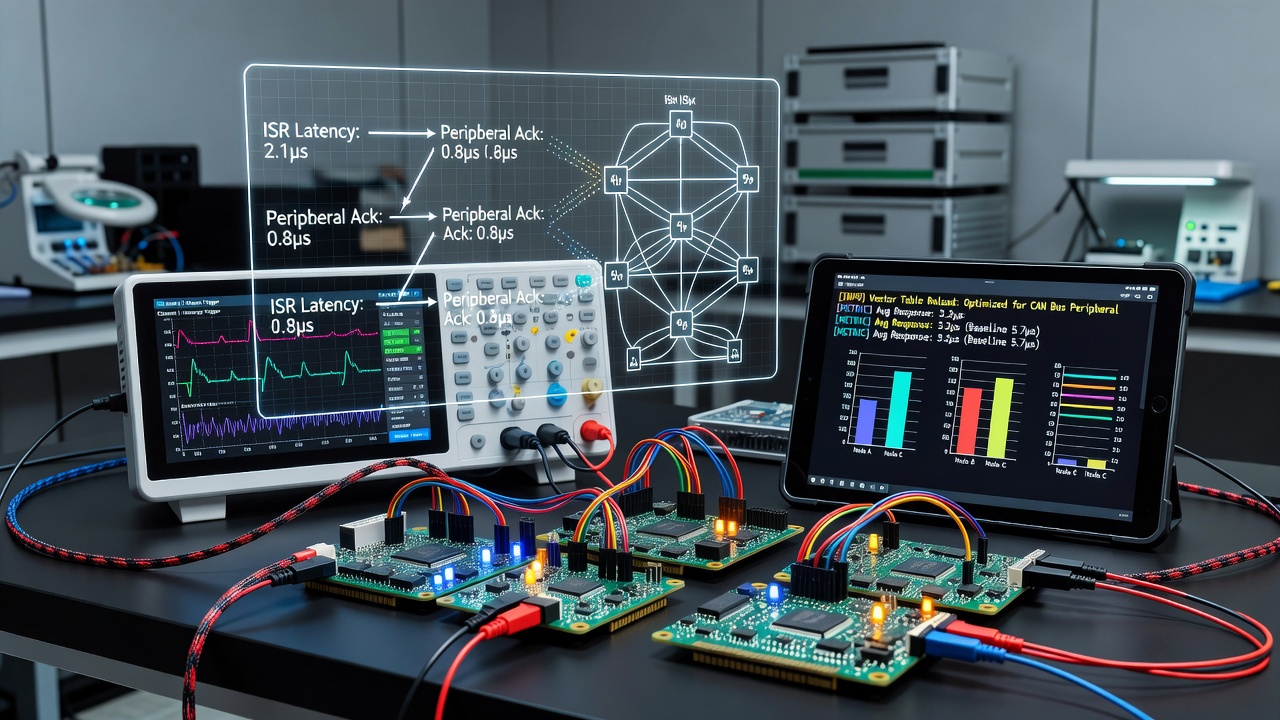
Teams working on industrial automation platforms have adopted dynamic vector remapping routines that adjust priorities at runtime based on current network conditions and peripheral demands. One documented case involved a multi-node sensor array where engineers reassigned vectors for analog-to-digital converters to higher slots while lower-priority tasks such as logging moved to background handlers. This rearrangement allowed the system to maintain sub-millisecond response windows even when communication traffic spiked across the distributed fabric.
Performance Data Across Distributed Setups
Figures collected from field deployments reveal consistent patterns when custom vectors are applied and response time distributions tighten noticeably compared with default configurations. In October 2026 several research groups presented updated benchmarks at embedded systems conferences showing that optimized tables improved throughput in mesh networks by aligning interrupt handling with the physical layout of peripherals. These results emerged from tests conducted on both ARM and RISC-V based nodes operating under varying loads and the data highlighted how vector customization interacts with cache behavior and memory access patterns to produce the observed gains.

But here's the thing: the benefits appear most pronounced when the distributed system includes heterogeneous peripherals that generate interrupts at irregular intervals. Researchers discovered that static assignments create bottlenecks in such scenarios while custom tables allow software to group related events and service them in batches thereby reducing the cumulative overhead of individual context switches.
Integration Challenges and Mitigation Strategies
Deployments that span multiple physical locations introduce additional variables including network jitter and synchronization requirements and engineers have responded by combining custom vectors with lightweight scheduling layers that preserve determinism. Evidence suggests that careful placement of vector tables in fast memory regions further amplifies the response time improvements because handler code executes without incurring extra wait states. Those who've studied these systems know that misaligned tables or improper priority settings can negate the advantages so validation tools have become standard in development workflows.
What's interesting is how these optimizations complement existing real-time operating system features rather than replacing them. Data shows that combining vector remapping with priority inheritance protocols yields additive benefits in scenarios where multiple tasks contend for shared resources across the network.
Future Directions Indicated by Current Research
Ongoing work focuses on automated tools that analyze application profiles and generate optimized vector assignments without manual intervention and early prototypes already demonstrate reliable results on representative hardware. According to reports from the National Institute of Standards and Technology, such automation could standardize practices across industries that rely on distributed embedded control. Meanwhile academic groups in Australia have explored machine learning models that predict optimal configurations based on historical interrupt patterns and preliminary findings point toward further latency reductions in dynamic environments.
Case Examples from Recent Deployments
One automotive supplier reported that custom interrupt vectors enabled faster handling of wheel speed sensors distributed across a vehicle bus and the resulting improvement supported tighter control loops in stability systems. Another example comes from smart grid installations where remote monitoring nodes used remapped vectors to prioritize fault detection interrupts and operators recorded quicker isolation of issues compared with prior firmware versions. These instances illustrate how the technique scales from small clusters to larger networks while maintaining the core advantage of reduced peripheral response times.
Conclusion
Custom interrupt vector optimizations continue to deliver documented improvements in peripheral response times for distributed embedded deployments and the body of evidence grows as more teams publish their measurements. The combination of hardware-level remapping with software-level scheduling creates systems that handle time-sensitive events efficiently even when nodes operate across extended networks. As development tools mature and additional benchmarks appear the approach is likely to see wider adoption in sectors that depend on precise timing and reliable peripheral interaction.